도쿄 구울 OC 메이커
도쿄 구울 OC 메이커
Tokyo Ghoul OC Maker — CCG Intelligence Briefing
DOCUMENT CLASSIFICATION: Internal Use Only — Commission of Counter Ghoul
This tokyo ghoul oc maker briefing contains tactical profiles, kagune generator analysis, and threat assessment frameworks for field operatives. Sections marked [GHOUL PERSPECTIVE] represent intercepted ghoul community intelligence and are included for strategic awareness.
PART A: Ghoul Threat Classification
All confirmed ghouls receive a CCG rating based on combat capability, territorial influence, and kill count. Your OC's rating determines their narrative weight in the setting.
| Rating | Threat Level | CCG Response | Design Implications |
|---|---|---|---|
| C | Low — newly emerged, unskilled | Single investigator | Young, frightened, still learning to control kagune |
| B | Moderate — established predator | Investigator pair | Functional fighter, has a territory and hunting pattern |
| A | High — significant combat ability | Full squad deployment | Experienced, has a reputation and likely a mask identity |
| S | Extreme — district-level threat | Special Class mobilization | Feared by name, likely leads or protects other ghouls |
| SS | Critical — multi-district influence | Joint operation required | Legendary figures. Designing at this tier demands serious justification |
| SSS | Catastrophic — existential threat | Director-level authorization | Canon has only a handful. Your OC almost certainly shouldn't be here |
Start your OC at C or B rating and let the story earn higher tiers. The most compelling Tokyo Ghoul characters — Kaneki, Touka, Hinami — began weak and grew through suffering.
PART B: Kagune Type Selection and Matchup System
A ghoul's kagune — the predatory organ released from RC cells — defines their combat role. Tokyo Ghoul uses a rock-paper-scissors matchup system between the four kagune types.
The RC Type Cycle:
Ukaku (wing/shoulder) → beats Bikaku (tail)
    ↑                         ↓
Koukaku (shoulder/arm)  ← beats ← Rinkaku (back/waist)
    ↓                         ↑
    → beats → Ukaku      Bikaku → beats → Rinkaku
Detailed kagune breakdown:
Ukaku (released from shoulder area)
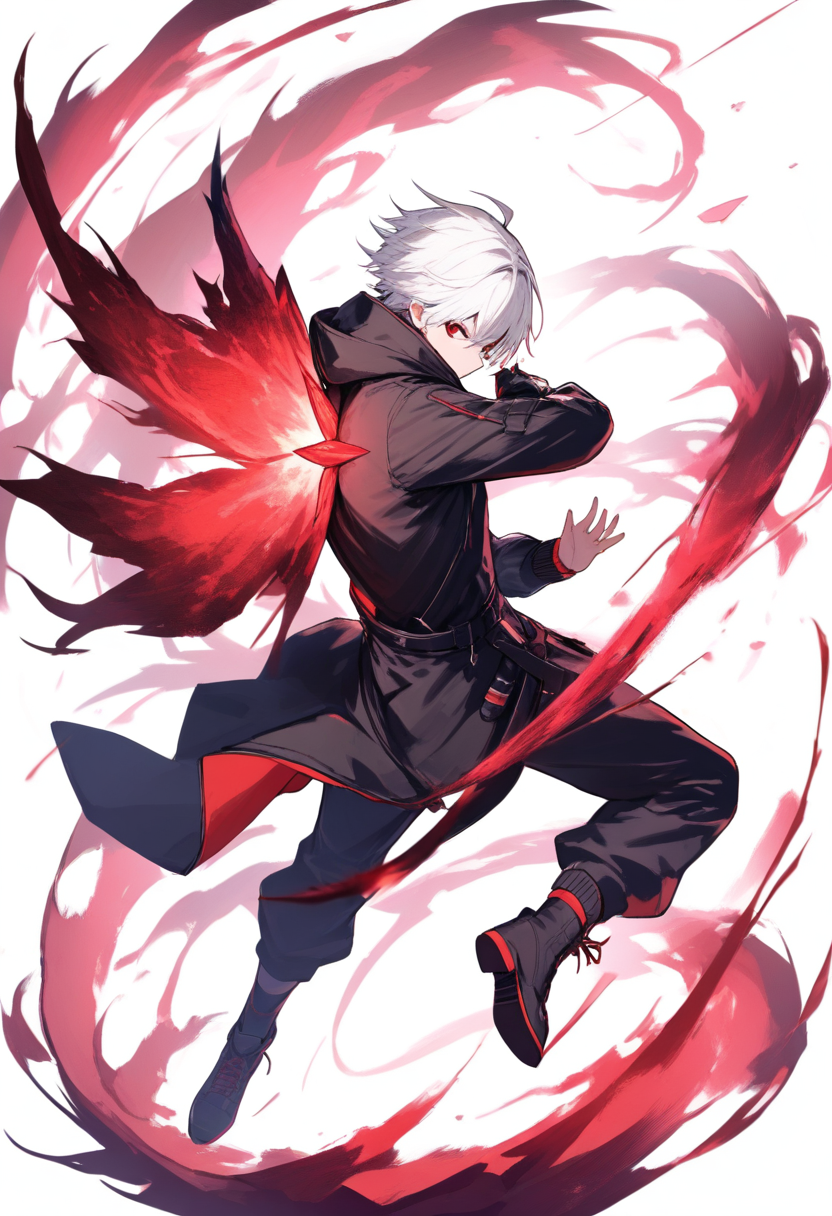
- Shape: Crystallized wing-like projections, capable of firing hardened shards
- Fighting style: Speed and ranged bombardment. Hit fast, overwhelm, retreat
- Weakness: Burns through RC cells rapidly. Extended fights are a death sentence
- OC personality match: Impulsive, passionate, prone to burnout — people who sprint through life
- Prompt keywords: crystalline wings, feather-like shards, shoulder-mounted, iridescent
Koukaku (released from below the shoulder blade)
- Shape: Dense, heavy, armor-like or blade-like formations
- Fighting style: Defensive tank. Absorbs hits, delivers devastating single strikes
- Weakness: Slow. A fast opponent can circle and exhaust them
- OC personality match: Stubborn, protective, immovable — the person who refuses to leave
- Prompt keywords: armored kagune, heavy blade, shield-like, metallic sheen
Rinkaku (released from the lower back)
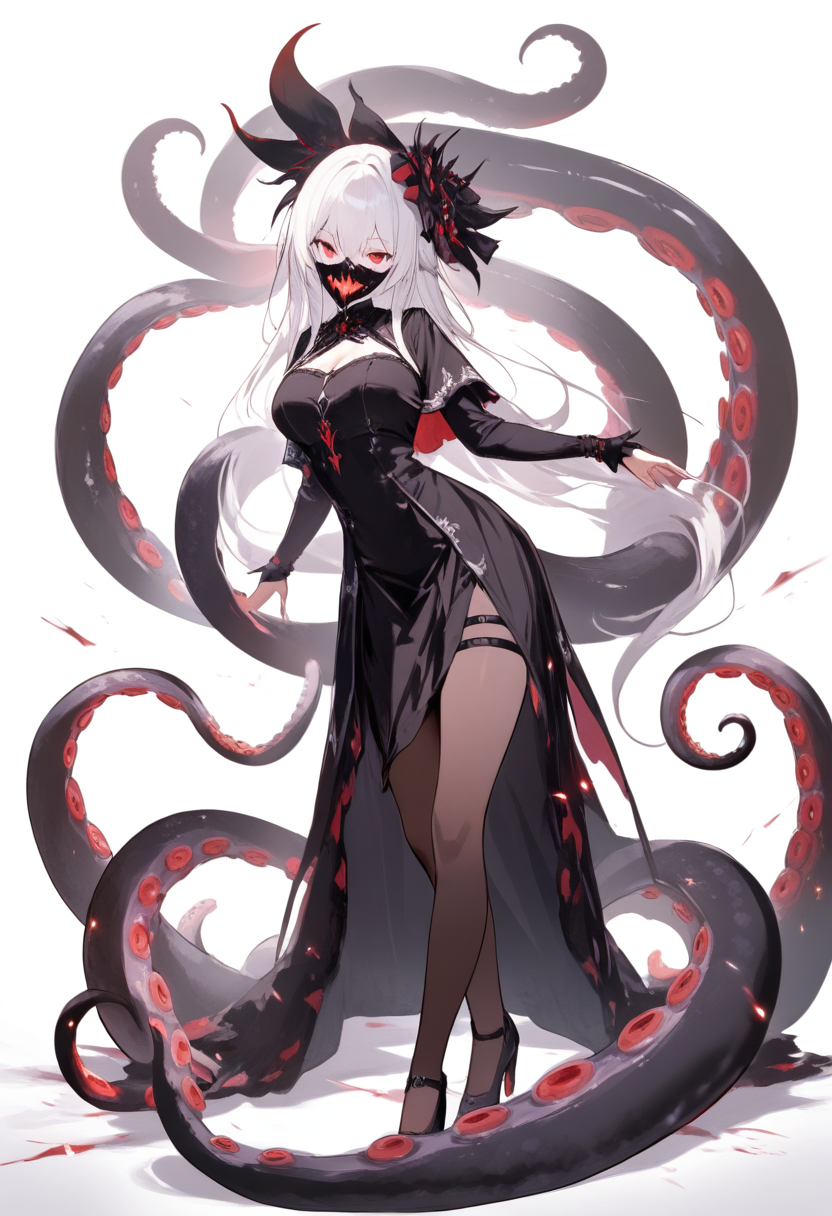
- Shape: Tentacle-like appendages, typically 2-8 tendrils
- Fighting style: High offensive output, piercing attacks, regeneration
- Weakness: Brittle. Each tendril is easily severed despite the regenerative ability
- OC personality match: Aggressive, resilient, keeps getting back up no matter the damage
- Prompt keywords: writhing tentacles, spine-like protrusions, scaled tendrils, multiple appendages
Bikaku (released from the tailbone)
- Shape: Tail-like appendage, most balanced kagune type
- Fighting style: All-rounder. Good offense, decent defense, no critical weakness
- Weakness: No critical strength either — a specialist of any other type has an edge in their domain
- OC personality match: Adaptable, balanced, hard to read — the survivor who never overcommits
- Prompt keywords: tail kagune, serpentine, flexible appendage, balanced stance
[GHOUL PERSPECTIVE] Mask Design as Identity
In the wards, a mask isn't protection — it's a declaration. The CCG catalogs ghouls by mask before anything else. Your OC's mask is the single most iconic piece of their visual identity.
Mask design philosophy from Tokyo Ghoul:
Kaneki's zipper mask — silence, the inability to speak his truth Touka's rabbit mask — innocence preserved behind violence Uta's own face — he has nothing to hide (which makes him terrifying) Ayato's black rabbit — inherited identity, living in his sister's shadow
Design your mask by answering:
- What does your ghoul hide from the world?
- What animal, object, or symbol represents that hidden thing?
- Does the mask cover the full face or only half? (Full = total separation of identities. Half = the two lives bleeding together.)
- What material? Leather is common, but porcelain, metal, bone-like resin, and stitched fabric all carry different connotations.
PART C: Investigator OC — The Other Side
Not every Tokyo Ghoul OC needs to be a ghoul. CCG investigators are compelling characters in their own right — humans who hunt predators that are physically superior to them in every way.
Investigator ranks and what they carry:
| Rank | Quinque Access | Typical Assignment |
|---|---|---|
| Rank 3 | Basic, often inherited or refurbished | Patrol, reconnaissance, ghoul tracking |
| Rank 2 | Standard issue, one quinque | Small-scale operations, backup for senior investigators |
| Rank 1 | Choice of quinque type, may carry two | Direct engagement, squad leadership |
| Associate Special Class | Custom quinque, high-RC models | High-priority targets, A-rated ghouls |
| Special Class | Experimental quinques, kakuja-derived weapons | SS/SSS operations, district-level threats |
Quinque design — A quinque is a weapon forged from a harvested kagune. It retains the RC type of the ghoul it came from, which means the matchup system applies to investigators too.
When designing your investigator's quinque, decide:
- Which kagune type was the source material?
- What weapon form did the CCG forge it into?
- Does the investigator know which ghoul their weapon came from? (This creates moral weight — especially if that ghoul was someone's parent, child, or friend.)
PART D: The Half-Ghoul Question
Half-ghouls — artificial or natural hybrids — are central to Tokyo Ghoul's narrative. Kaneki, Eto, the Quinx Squad. They're also the most popular OC category and the easiest to get wrong.
If your OC is a half-ghoul, establish:
- Origin: Surgery (like Kaneki), birth (like Eto), or Quinx procedure (CCG-sanctioned implant)?
- RC factor stability: Do they control their kagune reliably, or does it erupt under stress?
- Kakugan manifestation: One eye or both? Always active or only when the kagune deploys? (Single kakugan = half-ghoul marker in canon)
- Hunger: How do they handle the need to consume human flesh? This is the core moral tension of the entire series. Don't skip it.

PART E: Prompt Strategy for Tokyo Ghoul Characters
Tokyo Ghoul's art style is distinct — Ishida Sui uses heavy ink work, splattered textures, muted backgrounds with sudden bursts of red, and anguished body language. Lean into this:
"A Tokyo Ghoul-style ghoul with long disheveled white hair and a single red kakugan eye, wearing a tattered black coat, rinkaku kagune erupting from the lower back as four crimson tendrils, crouching on a rooftop at night, half-face leather mask with stitched mouth detail, ink splatter aesthetic"
Specify the kakugan (red iris on black sclera), the kagune type and position, and the mask. These three elements are the visual trinity of any Tokyo Ghoul character.
Frequently Asked Questions
Can my OC have two kagune types? Only through chimera biology (extremely rare, kakuja-adjacent) or Quinx modifications. A standard ghoul has one RC type. Kakuja — an evolved state from cannibalism — can produce armored mutations but technically remains the same RC type.
Should my investigator OC be sympathetic to ghouls? The most interesting ones usually are, at least partially. Tokyo Ghoul's thesis is that the line between human and monster is artificial. An investigator who never questions the system is flat.
How graphic should the hunger element be? It's central to the series. You don't need gore, but your OC must grapple with what they eat. The coffee detail — ghouls can only consume coffee and human flesh — is small but essential for establishing daily life scenes.
Can my OC be from outside Tokyo? Yes. The manga hints at ghoul populations worldwide. A ghoul OC arriving in Tokyo from another country creates immediate fish-out-of-water tension with unfamiliar ward politics.
Related Character Tools
Chainsaw Man OC Maker
Create Chainsaw Man characters with devil contracts and hybrid transformations.
Bleach OC Maker
Design Bleach original characters with Zanpakuto releases and Soul Reaper uniforms.
Attack on Titan OC Maker
Create Attack on Titan characters with ODM gear and Survey Corps uniforms.
JJK OC Maker
Design Jujutsu Kaisen original characters with cursed techniques and sorcerer styles.
Hunter x Hunter OC Maker
Create Hunter x Hunter characters with Nen abilities and Hunter licenses.
OC Generator
Create original characters for any fandom or original universe with AI.
나만의 도쿄 구울 OC 만들기
오리지널 구울을 디자인하세요. AI로 카구네와 카쿠간을 가진 도쿄 구울 캐릭터를 만들어 보세요!