ダンガンロンパ OCメーカー
ダンガンロンパ OCメーカー
The Talent Is the Trap
In Danganronpa, every character walks into the killing game carrying one thing that defines them completely: their Ultimate Talent. The Ultimate Pianist plays piano. The Ultimate Detective solves cases. The Ultimate Nurse heals people. Simple, right?
Except the talent isn't just a skill — it's a cage. It determines how everyone perceives them, what role they're forced into during the killing game, and ultimately how they live or die. The Ultimate Swordswoman is expected to protect everyone. The Ultimate Programmer is expected to hack through security systems. The Ultimate Lucky Student is expected to survive on dumb luck alone. Your OC's talent isn't a resume line. It's the single narrative thread that everything else hangs from.
Choosing the Ultimate Talent
The talent selection is the most consequential creative decision for a Danganronpa OC. It needs to satisfy three criteria simultaneously:
-
It's specific enough to be a title. Not "Ultimate Artist" but "Ultimate Calligrapher." Not "Ultimate Fighter" but "Ultimate Aikido Master." Danganronpa talents are narrow.
-
It creates both advantages and vulnerabilities in a killing game. The Ultimate Pharmacist can heal people — and also knows exactly how to poison them. The Ultimate Locksmith can secure a room — and also break into one.
-
It can be subverted. The best Danganronpa characters turn their talent against expectations. Celestia Ludenberg, the Ultimate Gambler, doesn't gamble in the killing game — she manipulates people, because that's what gambling really taught her. Miu Iruma, the Ultimate Inventor, creates both tools for survival and instruments of death.
Talent categories and their killing game dynamics:
| Category | Example Talents | Investigation Use | Murder Potential | Survival Edge |
|---|---|---|---|---|
| Academic | Historian, Linguist, Mathematician | Pattern recognition, decoding clues | Obscure knowledge of poisons, codes | Low physical threat = underestimated |
| Athletic | Swimmer, Gymnast, Martial Artist | Physical evidence analysis, reconstructing crime scenes | Physical capability, access to training equipment | Can fight back, harder to kill |
| Creative | Sculptor, Composer, Filmmaker | Understanding staging, recognizing forgeries | Can fabricate evidence, stage crime scenes | Psychological insight into others |
| Technical | Mechanic, Hacker, Engineer | Analyzing mechanisms, understanding security | Can build weapons, disable systems | Controls the environment |
| Social | Diplomat, Therapist, Politician | Reading people, extracting confessions | Manipulation, gaslighting, forming alliances | People trust them (mistake) |
| Niche | Entomologist, Astronaut, Cosplayer | Hyper-specific expertise that becomes crucial | Unexpected knowledge turns lethal | Nobody sees them as a threat |
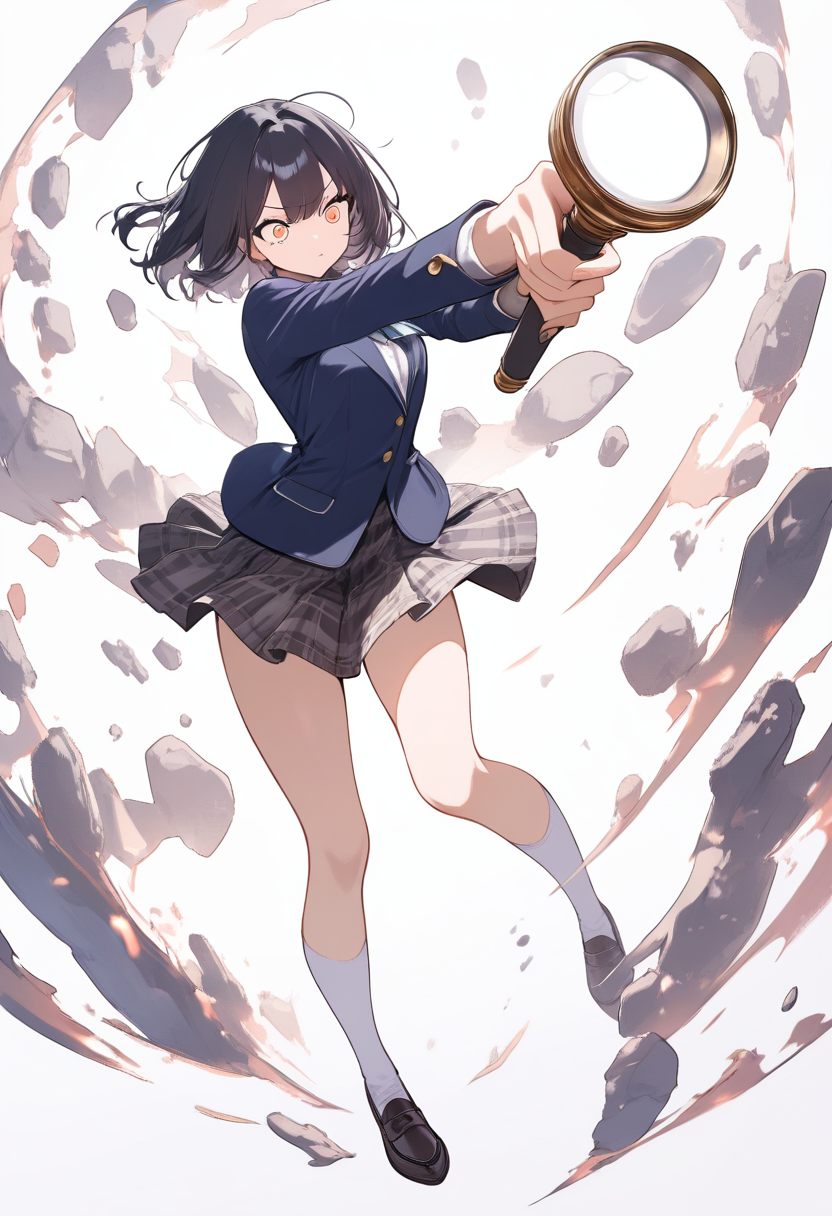
The Silhouette Test: Danganronpa Visual Design
Danganronpa characters are designed to be instantly recognizable in silhouette. Spike Chunsoft's character designer Rui Komatsuzaki follows strict principles that give the series its iconic look:
Bold outlines. Every character has thick, clean black outlines that separate them from backgrounds. This isn't subtle linework — it's graphic design.
Distinct silhouettes. Cover a Danganronpa character in shadow and you can still tell who they are. Junko has the twin pigtails. Gundham has the hamsters and the scarf. Kokichi has the checker scarf and compact proportions. Your OC needs ONE silhouette feature that's uniquely theirs.
Color coding. Each character owns a color. Not just in their outfit — in their entire presence. Kaede is pink. Shuichi is dark blue. Miu is pink-and-blue. Korekiyo is green. Pick one dominant color and make your OC own it.
The ahoge rule. Danganronpa protagonists have an ahoge (the sticking-up hair strand). It's not just a design quirk — it's a visual shorthand that tells the audience "this is the person you're following." If your OC is a protagonist, give them the ahoge. If they're not, don't.
Outfit as personality statement. Danganronpa characters wear their personality. Byakuya's suit screams wealth and control. Ibuki's punk outfit screams chaos. Kaito's jacket screams ambition. What does your OC's outfit scream at first glance?
Character Archetypes in the Killing Game
Every Danganronpa cast is an ensemble, and each member fills a narrative role. Understanding these roles helps you design an OC who fits the dynamic.
The Hope — The character who believes escape is possible, who rallies others, who refuses to give in to despair. Usually (but not always) the protagonist. They're often naive, which is both their strength and their risk. (Makoto, Kaede initially)
The Despair — The character drawn toward the darkness of the killing game. They may be the mastermind, a traitor, or simply someone who breaks under pressure. Their design often hides this role behind a different facade. (Junko behind Monokuma, the Chapter 1 twist killers)
The Wild Card — Unpredictable. They might help, might hinder, might die, might kill. The audience and the other characters can't read them. This is the most dangerous and most entertaining archetype. (Nagito, Kokichi, Celestia)
The Moral Compass — Takes ethics seriously. Often the first to call out suspicious behavior and the first to suffer for it. Their death — if it comes — destabilizes the group more than anyone else's. (Peko in her loyalty to Fuyuhiko, Sakura Ogami)
The Comic Relief — Provides levity. Often underestimated. Sometimes they survive to the end precisely because nobody saw them as a threat. Sometimes they die early to signal that the game is serious. (Hifumi, Kazuichi, Tenko)
The Rival — Opposes the protagonist ideologically or methodologically. Not necessarily antagonistic — just fundamentally different in approach. Their class trials are the most electric. (Byakuya, Nagito, Kokichi)
Free Time Events: Building Backstory Depth
In the games, Free Time Events (FTEs) are optional conversations that reveal a character's hidden depth. For your OC, designing their FTE arc means answering: what's underneath the talent?
The FTE structure — each conversation peels back a layer:
- Surface — Your OC talks about their talent. How they got it, what they think of it, their public relationship to it.
- Complication — Something doesn't add up. They hate their talent, or they didn't earn it, or it cost them something personal.
- Vulnerability — The real person emerges. What they wanted before the talent defined them. Who they lost. What they're afraid of.
- Resolution — They either accept their talent as part of themselves or reject it entirely. This is the moment of genuine connection.
- Undermine or Affirm — In classic Danganronpa fashion, the final FTE either confirms everything you learned... or reveals one last devastating twist.
The best FTE backstories create dramatic irony in the killing game. If you know the Ultimate Surgeon lost a patient due to a tremor in their hands, every moment they need to perform under pressure in the game becomes agonizing.
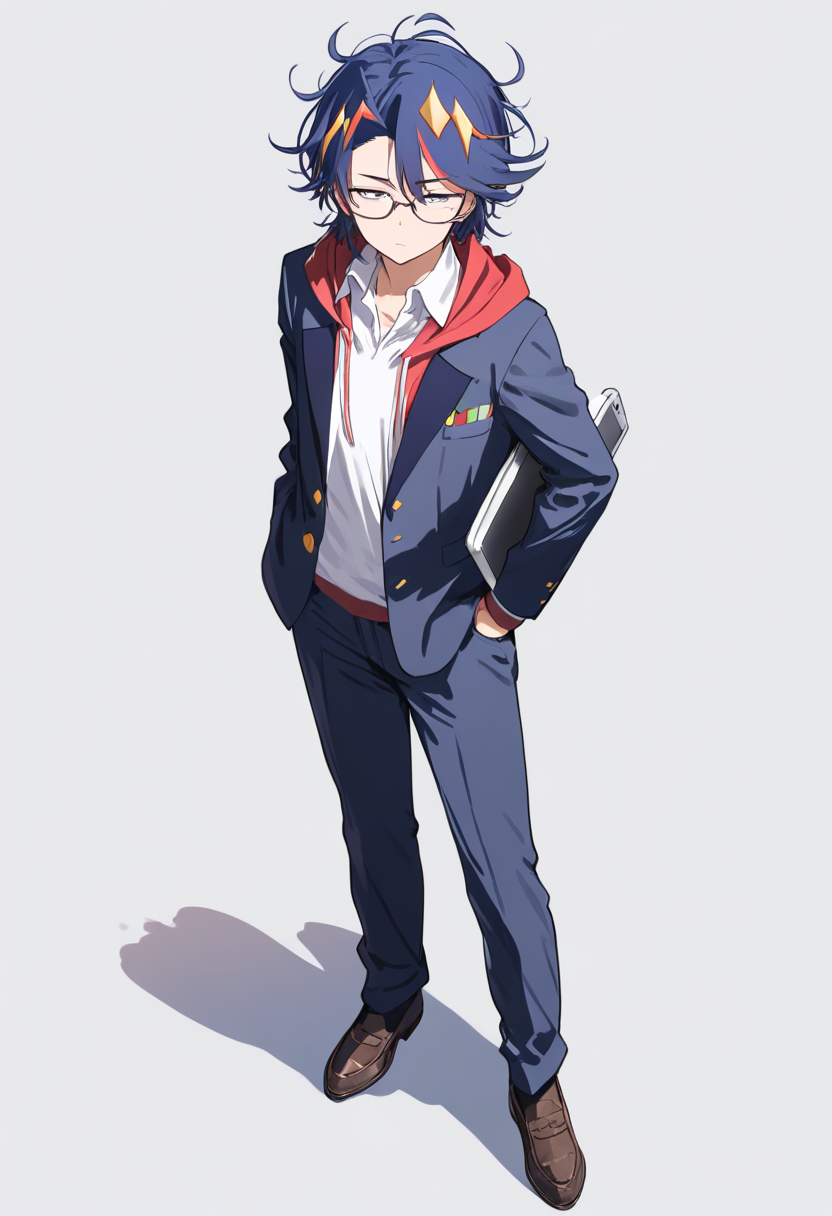
Execution Design: Talent Turned Against Them
Danganronpa executions are darkly creative spectacles where a character's talent is used as the instrument of their punishment. If your OC is a potential victim of execution, designing their punishment is designing the cruelest possible mirror.
The formula: Take the talent. Find its most aspirational quality. Invert it into torment.
- The Ultimate Pianist is forced to play a song that triggers her own execution mechanism — the music she loved becomes the thing that kills her
- The Ultimate Baseball Star is launched from a pitching machine into space — his athletic pride becomes the launch pad
- The Ultimate Chef is baked alive — the kitchen that was their sanctuary becomes an oven
For your OC: What does their talent look like when it turns against them? What's the one scenario where being the best at their thing is the worst possible outcome? That's the execution.
This isn't just morbid creativity — it's thematic design. The execution should make the audience think "that's horrible... and it's poetic."
Prompt Strategy for Danganronpa OCs
Danganronpa's art style has specific requirements for AI generation:
"A Danganronpa-style character portrait, bold black outlines, flat shading with sharp shadows, [color] dominant palette, [talent]-themed accessories, confident/dramatic expression, school uniform variant with personal modifications, high contrast, clean graphic design style"
Key elements that sell the Danganronpa look:
- Thick outlines (thicker than most anime)
- Flat color blocks with minimal gradient
- High contrast between light and shadow
- Uniform base with personal modifications (everyone attends Hope's Peak, but nobody dresses the same)
- Accessories that reference the talent without being costumes (a conductor's baton in a pocket, not a full tuxedo)
Frequently Asked Questions
Can my OC be the Ultimate Lucky Student? Yes — it's a canon talent that recurs across games (Makoto, Nagito, Hajime's cover story). But Lucky Students work best when their luck is genuinely ambiguous: sometimes it saves them, sometimes it puts them in worse danger. Nagito's luck is terrifying precisely because it's uncontrollable.
Should my OC survive the killing game? Statistically, most participants don't. Designing your OC with a potential death chapter and execution in mind actually strengthens the character — it forces you to think about their arc as finite. Survivors need a different kind of depth: the guilt, the trauma, the question of why they made it out.
How important is the school uniform? Very. Hope's Peak Academy requires a uniform, but every student modifies it. The modifications ARE the character design. A rolled-up sleeve, a custom jacket replacement, pins and patches, a completely ignored dress code — how your OC treats the uniform tells you who they are before they speak.
Can my OC be the mastermind? Yes, but the mastermind needs to be designed twice: once as they present themselves to the group, and once as they actually are. The gap between those two designs is the twist. The best masterminds are characters the audience genuinely liked before the reveal.
What about the Ultimate Despair / Future Foundation context? Danganronpa's wider world includes the Ultimate Despair (Junko's brainwashed followers) and the Future Foundation (the resistance). OCs in these factions follow different design rules — Despair characters have a corrupted version of their talent aesthetic, while Future Foundation members wear professional attire with division-specific modifications.
Related Character Tools
Undertale OC Maker
Create Undertale original characters with pixel-art style and unique soul traits.
RWBY OC Maker
Design RWBY original characters with Semblances, weapons, and team roles.
Hazbin Hotel OC Maker
Design Hazbin Hotel original characters with demon forms and unique styles.
FNAF OC Maker
Create Five Nights at Freddy's original animatronic and character designs.
OC Generator
Create original characters for any fandom or original universe with AI.
ダンガンロンパのOCを作ろう
あなただけの超高校級のキャラクターを作成しましょう。ダンガンロンパOCメーカーで、オリジナルの生徒をデザインできます。